


The Shot
That Stayed
A bullet hole, a beautiful old bar, several famous suspects—and one story that has had more than a century to improve itself.
Every old saloon worth its whiskey ought to have at least one story that improves slightly with age. At the Lacey Rose Saloon, that story is still lodged—quite literally—behind the bar.
A grand room in a not-yet-tame town
The building around it began life during Silverton’s great mining boom. Commissioned in 1882 and completed in 1883, the Grand Hotel was one of the showpieces of the young town: an imposing Victorian building filled not only with hotel rooms, but with offices, businesses and, for a time, portions of Silverton’s town and county government. It was the sort of place where prospectors, businessmen, politicians and characters of less easily defined occupation might all find themselves under the same roof.
The building was not merely a place to sleep. Offices and civic business shared the structure, while commerce filled the lower floor. Over time, the saloon became one of the rooms in which Silverton’s respectable ambitions and its less respectable habits were allowed to sit uncomfortably close together.
And then there was the barIts magnificent old back bar has almost as much history as the building itself. A 1961 history of Silverton describes it as a mahogany bar made in Denver and shipped to Silverton in sections by railroad, with three great plate-glass mirrors brought from France. Architectural historians still single out the elaborate back bar as one of the remarkable features of the Grand Imperial.
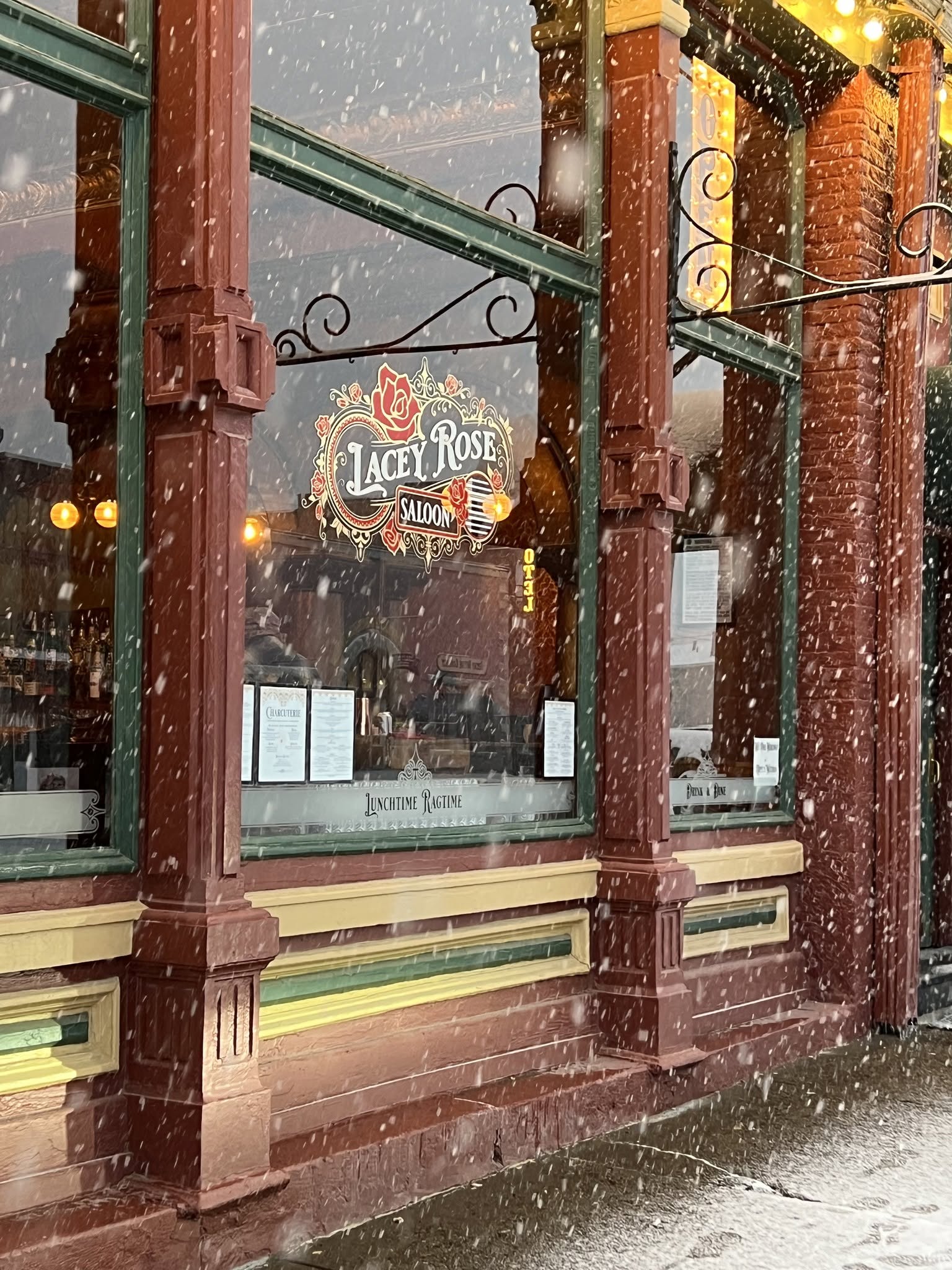
The Lacey Rose Saloon at the historic Grand Imperial Hotel. Image: Lacey Rose Saloon.
Then somebody shot it.
That is the wonderfully simple part of the story. Somewhere in Silverton’s long, loud frontier years, a bullet found the ornate back bar and left behind a mark that outlived the argument, the drink, the arrest—or whatever else was happening at the time.
The surviving hole is the artifact. The rest comes to us through local history, later retellings and competing versions of the legend.
Who pulled the trigger?
Here the story divides into several very Silverton possibilities.
Bat Masterson
The best-known version gives the shot to the famous lawman. A 1961 history of Silverton says the town council once hired Masterson to help “clean up the town,” so his presence in the local story is not invented from whole cloth. Later tellings connect him directly to the bullet hole—sometimes during an arrest, sometimes with considerably fewer details.
Wyatt or Doc
Some tellings have wondered whether the shot might instead have belonged to Wyatt Earp or Doc Holliday, both of whom were associated with Silverton during the same wonderfully unruly period.
Rosie’s jealous suitor
A 1988 Los Angeles Times travel story offered an entirely different version: the bullet was fired by the jealous suitor of a woman named Rosie Steward. Rosie survived. The bar, according to the paper, “took” the hit.
After more than a century, the bullet hole isn't talking.
There is no need to choose a winner. The charm lies in knowing where the floorboards of history end and the trapdoor of folklore begins.
The Grand Imperial building dates to Silverton’s early-1880s boom and remains a landmark in the town’s historic district.
Local historical writing places Bat Masterson in Silverton after town leaders sought help restoring order.
Later accounts identify Masterson—or sometimes Earp or Holliday—as the person who put the bullet into the bar.
The Los Angeles Times recorded the Rosie Steward version in 1988, showing that the legend already had more than one well-traveled ending.
The hole remains the wonderfully stubborn bit of physical evidence around which all the stories orbit.
Somebody missed and the saloon has been telling the story ever since.
The gunfire is gone. The story stayed.
Today the old room is the Lacey Rose Saloon, where the more common soundtrack is conversation, clinking glassware and ragtime piano. The woodwork is still there. The history is still there. And so is the little imperfection that has given generations of bartenders something irresistible to point at.
Was it Bat Masterson? A jealous suitor? Someone whose name never made it into the newspapers at all?
After this long, certainty would almost spoil it. Silverton has always been particularly good at keeping one boot in history and the other in a story too entertaining to throw away.
Come find the hole for yourself.
Lacey Rose Saloon · 1219 Greene Street · Silverton, Colorado

Historical notes & source trail
- Lacey Rose Saloon — present-day location and the saloon’s account of the Grand Imperial’s early-1880s origins.
- Library of Congress, Historic American Buildings Survey — Grand Imperial Hotel documentation within the Silverton Historic District.
- The Silverton Story, Mary Ann Olsen — early local history describing the town council hiring Bat Masterson to help restore order.
- Wyoming in Motion — later retelling of the Masterson / Earp / Holliday bullet-hole folklore.
- Los Angeles Times, July 17, 1988 — the Rosie Steward / jealous-suitor version of the tale.